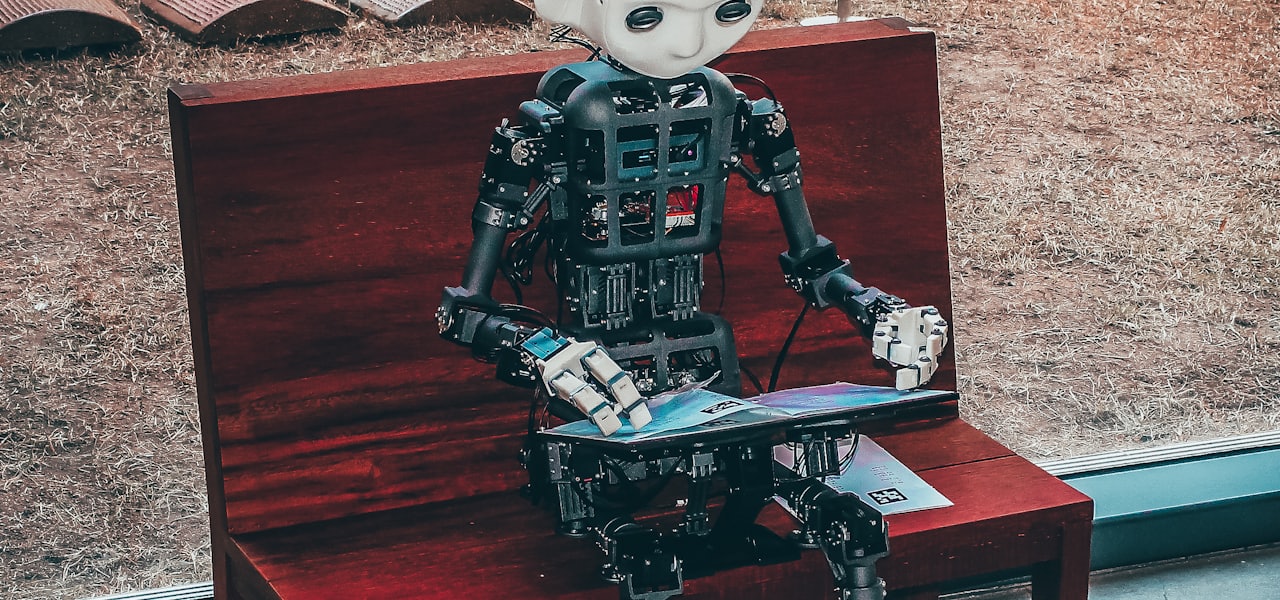
R.U.R. is a 1920 science fiction play by the Czech writer Karel Čapek. "R.U.R." stands for Rossumovi Univerzální Roboti (Rossum's Universal Robots, a phrase that has been used as a subtitle in English versions). The play had its world premiere on 2 January 1921 in Hradec Králové. It introduced the word "robot" to the English language and to science fiction as a whole. R.U.R. became influential soon after its publication. By 1923, it had been translated into thirty languages. R.U.R. was successful in its time in Europe and North America. Čapek later took a different approach to the same theme in his 1936 novel War with the Newts, in which non-humans become a servant-class in human society. == Characters == Parentheses indicate names which vary according to translation. On the meaning of the names, see Ivan Klíma: Karel Čapek: Life and Work (2002). == Plot == === Synopsis === The play begins in a factory that makes artificial workers from synthetic organic matter. (As living creatures of artificial flesh and blood, that later terminology would call androids, the playwright's 'roboti' differ from later fictional and scientific concepts of inorganic constructs.) Robots may be mistaken for humans but have no original thoughts. Though most are content to work for humans, eventually a rebellion causes the extinction of the human race. === Prologue (Act I in the Selver translation) === Helena, the daughter of the president of a major industrial power, arrives at the island factory of Rossum's Universal Robots. Here, she meets Domin, the General Manager of R.U.R., who relates to her the history of the company. Rossum had come to the island in 1920 to study marine biology. In 1932, Rossum had invented a substance like organic matter, though with a different chemical composition. He argued with his nephew about their motivations for creating artificial life. While the elder wanted to create animals to prove or disprove the existence of God, his nephew only wanted to become rich. Young Rossum finally locked away his uncle in a lab to play with the monstrosities he had created and created thousands of robots. By the time the play takes place (circa the year 2000), robots are cheap and available all over the world. They have become essential for industry. After meeting the heads of R.U.R., Helena reveals that she is a representative of the League of Humanity, an organization that wishes to liberate the robots. The managers of the factory find this absurd. They see robots as appliances. Helena asks that the robots be paid, but according to R.U.R. management, the robots do not "like" anything. Eventually Helena is convinced that the League of Humanity is a waste of money, but still argues robots have a "soul". Later, Domin confesses that he loves Helena and forces her into an engagement. === Act I (Act II in Selver) === Ten years have passed. Helena and her nurse Nana discuss current events, the decline in human births in particular. Helena and Domin reminisce about the day they met and summarize the last ten years of world history, which has been shaped by the new worldwide robot-based economy. Helena meets Dr. Gall's new experiment, Radius. Dr. Gall describes his experimental robotess, also named Helena. Both are more advanced, fully-featured robots. In secret, Helena burns the formula required to create robots. The revolt of the robots reaches Rossum's island as the act ends. === Act II (Act III in Selver) === The characters sense that the very universality of the robots presents a danger. Echoing the story of the Tower of Babel, the characters discuss whether creating national robots who were unable to communicate beyond their languages would have been a good idea. As robot forces lay siege to the factory, Helena reveals she has burned the formula necessary to make new robots. The characters lament the end of humanity and defend their actions, despite the fact that their imminent deaths are a direct result of their choices. Busman is killed while attempting to negotiate a peace with the robots. The robots storm the factory and kill all the humans except for Alquist, the company's Clerk of the Works (Head of Construction). The robots spare him because they recognize that "He works with his hands like a robot. He builds houses. He can work." === Act III (Epilogue in Selver) === Years have passed. Alquist, who still lives, attempts to recreate the formula that Helena destroyed. He is a mechanical engineer, though, with insufficient knowledge of biochemistry, so he has made little progress. The robot government has searched for surviving humans to help Alquist and found none alive. Officials from the robot government beg him to complete the formula, even if it means he will have to kill and dissect other robots for it. Alquist yields. He will kill and dissect robots, thus completing the circle of violence begun in Act Two. Alquist is disgusted. Robot Primus and Helena develop human feelings and fall in love. Playing a hunch, Alquist threatens to dissect Primus and then Helena; each begs him to take him- or herself and spare the other. Alquist now realizes that Primus and Helena are the new Adam and Eve, and gives the charge of the world to them. == Čapek's conception of robots == The robots described in Čapek's play are not robots in the popularly understood sense of an automaton. They are not mechanical devices, but rather artificial biological organisms that may be mistaken for humans. A comic scene at the beginning of the play shows Helena arguing with her future husband, Harry Domin, because she cannot believe his secretary is a robotess: His robots resemble more modern conceptions of man-made life forms, such as the Replicants in Blade Runner, the "hosts" in the Westworld TV series and the humanoid Cylons in the re-imagined Battlestar Galactica, but in Čapek's time there was no conception of modern genetic engineering (DNA's role in heredity was not confirmed until 1952). There are descriptions of kneading-troughs for robot skin, great vats for liver and brains, and a factory for producing bones. Nerve fibers, arteries, and intestines are spun on factory bobbins, while the robots themselves are assembled like automobiles. Čapek's robots are living biological beings, but they are still assembled, as opposed to grown or born. One critic has described Čapek's robots as epitomizing "the traumatic transformation of modern society by the First World War and the Fordist assembly line". === Origin of the word robot === The play introduced the word robot, which displaced older words such as "automaton" or "android" in languages around the world. In an article in Lidové noviny, Karel Čapek named his brother Josef as the true inventor of the word. In Czech, robota means forced labour of the kind that serfs had to perform on their masters' lands and is derived from rab, meaning "slave". The name Rossum is an allusion to the Czech word rozum, meaning "reason", "wisdom", "intellect" or "common sense". It has been suggested that the allusion might be preserved by translating "Rossum" as "Reason" but only the Majer/Porter version translates the word as "Reason". == Production history and translations == The work was published in two differing versions in Prague by Aventinum, first in 1920, followed by a revised version in 1921. After being postponed, it premiered at the city's National Theatre on 25 January 1921, although an amateur group had by then already presented a production. By 1921, Paul Selver translated either the original 1920 edition of R.U.R. or a manuscript copy close to this version into English. He probably translated the play freelance, and sold it to St Martin's Theatre in London. Selver's translation was adapted for the British stage by Nigel Playfair in 1922, but it was not produced straight away. Later that year performance rights for the U.S. and Canada were sold to the New York Theatre Guild, perhaps during Lawrence Langner's visit to Britain. Playfair's version included several changes to Čapek's original play, such as renaming the acts (the prologue became act one, and the heavily abridged final act became the epilogue), omitting around sixty lines (including most of Alquist's final speech), adding several more lines, and removing the robot character Damon (giving his lines to Radius). The omission of some lines may have been censorship from the Lord Chamberlain's Office, or self-censorship in anticipation of this, while some other changes might have been made by Čapek himself if Selver was working from a manuscript copy. An edition of Playfair's adaptation was published by the Oxford University Press in 1923, and Selver went on to write a satiric novel One, Two, Three (1926) based on his experiences getting R.U.R. staged. The American première was produced by the Theatre Guild at the Garrick Theatre in New York City in October 1922, where it ran for 184 performances. In the first performance, Domin was portrayed by Basil Sydney,
Subvocal recognition
Subvocal recognition (SVR) is the process of taking subvocalization and converting the detected results to a digital output, aural or text-based. A silent speech interface is a device that allows speech communication without using the sound made when people vocalize their speech sounds. It works by the computer identifying the phonemes that an individual pronounces from nonauditory sources of information about their speech movements. These are then used to recreate the speech using speech synthesis. == Input methods == Silent speech interface systems have been created using ultrasound and optical camera input of tongue and lip movements. Electromagnetic devices are another technique for tracking tongue and lip movements. The detection of speech movements by electromyography of speech articulator muscles and the larynx is another technique. Another source of information is the vocal tract resonance signals that get transmitted through bone conduction called non-audible murmurs. They have also been created as a brain–computer interface using brain activity in the motor cortex obtained from intracortical microelectrodes. == Uses == Such devices are created as aids to those unable to create the sound phonation needed for audible speech such as after laryngectomies. Another use is for communication when speech is masked by background noise or distorted by self-contained breathing apparatus. A further practical use is where a need exists for silent communication, such as when privacy is required in a public place, or hands-free data silent transmission is needed during a military or security operation. In 2002, the Japanese company NTT DoCoMo announced it had created a silent mobile phone using electromyography and imaging of lip movement. The company stated that "the spur to developing such a phone was ridding public places of noise," adding that, "the technology is also expected to help people who have permanently lost their voice." The feasibility of using silent speech interfaces for practical communication has since then been shown. In 2019, Arnav Kapur, a researcher from the Massachusetts Institute of Technology, conducted a study known as AlterEgo. Its implementation of the silent speech interface enables direct communication between the human brain and external devices through stimulation of the speech muscles. By leveraging neural signals associated with speech and language, the AlterEgo system deciphers the user's intended words and translates them into text or commands without the need for audible speech. == Research and patents == With a grant from the U.S. Army, research into synthetic telepathy using subvocalization is taking place at the University of California, Irvine under lead scientist Mike D'Zmura. NASA's Ames Research Laboratory in Mountain View, California, under the supervision of Charles Jorgensen is conducting subvocalization research. The Brain Computer Interface R&D program at Wadsworth Center under the New York State Department of Health has confirmed the existing ability to decipher consonants and vowels from imagined speech, which allows for brain-based communication using imagined speech, however using EEGs instead of subvocalization techniques. US Patents on silent communication technologies include: US Patent 6587729 "Apparatus for audibly communicating speech using the radio frequency hearing effect", US Patent 5159703 "Silent subliminal presentation system", US Patent 6011991 "Communication system and method including brain wave analysis and/or use of brain activity", US Patent 3951134 "Apparatus and method for remotely monitoring and altering brain waves". Latter two rely on brain wave analysis. == In fiction == The decoding of silent speech using a computer played an important role in Arthur C. Clarke's story and Stanley Kubrick's associated film A Space Odyssey. In this, HAL 9000, a computer controlling spaceship Discovery One, bound for Jupiter, discovers a plot to deactivate it by the mission astronauts Dave Bowman and Frank Poole through lip reading their conversations. In Orson Scott Card's series (including Ender's Game), the artificial intelligence can be spoken to while the protagonist wears a movement sensor in his jaw, enabling him to converse with the AI without making noise. He also wears an ear implant. In Speaker for the Dead and subsequent novels, author Orson Scott Card described an ear implant, called a "jewel", that allows subvocal communication with computer systems. Author Robert J. Sawyer made use of subvocal recognition to allow silent commands to the cybernetic 'companion implants' used by the advanced Neanderthal characters in his Neanderthal Parallax trilogy of science fiction novels. In Earth, David Brin depicts this technology and its uses as a normal gear in the near future. In Down and Out in the Magic Kingdom, Cory Doctorow has cellphone technology become silent through a cochlear implant and miking the throat to pick up subvocalization. William Gibson's Sprawl Trilogy frequently uses sub-vocalization systems in various devices. In Kage Baker's Company novels, the immortal cyborgs communicate subvocally. In the Hugo Award-winning Hyperion Cantos by Dan Simmons, the characters often use subvocalization to communicate. In the Culture novels by Iain M. Banks, more highly advanced species often communicate subvocally through their technology. In Deus Ex: Human Revolution (2011), the protagonist is augmented with a subvocalization implant for sending covert communications (and a corresponding cochlear implant for receiving covert communications). In the tabletop RPG and video game series Shadowrun, player characters can communicate via subvocal microphones in some instances. In Paranoia, all citizens can speak to the computer via their "cerebral cortech" implants. Alistair Reynolds Revelation Space trilogy frequently uses sub-vocalization systems in various devices.
Sunrise Calendar
Sunrise is a discontinued electronic calendar application for mobile and desktop. The service was launched in 2013 by designers Pierre Valade and Jeremy Le Van. In October 2015, Microsoft announced that they had merged the Sunrise Calendar team into the larger Microsoft Outlook team where they will work closely with the Microsoft Outlook Mobile service. == History == The first iteration of Sunrise launched in 2012 and was a daily email digest of appointments, events and birthdays. Sunrise was launched initially as an iPhone application on February 19, 2013. In June 2013, Sunrise raised $2.2 million (~$2.91 million in 2024) in venture funding from Resolute.vc, NextView Ventures, Lerer Hippeau Ventures, SV Angel, and other angel investment firms like Loïc Le Meur, Dave Morin, Fabrice Grinda. In May 2014, Sunrise launched on Android as well as on the web via a web application. In July 2014, Sunrise announced it had raised $6 million (~$7.81 million in 2024) Series A from Balderton Capital. Bernard Liautaud joined the board. On February 11, 2015, Sunrise Atelier, Inc. was acquired by Microsoft for US$100 million (~$129 million in 2024). On October 28, 2015, Microsoft announced that Sunrise would be discontinued, and its functionality merged into Outlook Mobile. Microsoft later stated that the app would permanently cease functioning on August 31, 2016, but the shutdown was delayed to September 13, 2016, to coincide with an update to Outlook Mobile that incorporates aspects of Sunrise into its calendar interface. == Features == Sunrise allowed users to connect with Google Calendar, iCloud calendar and with Exchange Server. The following third-party services featured integration with Sunrise: Foursquare, GitHub, TripIt, Asana, Evernote, Google Tasks, Trello, Songkick, and Wunderlist. As a web app, users could sign-in and use Sunrise in a web browser, with no downloads required. A native Sunrise app could also be downloaded for OS X 10.9 and later, iOS 8.0 and later (both iPhone and iPad) as well as Android phones and tablets. In May 2015, Sunrise launched Meet, a keyboard for Android and iOS that lets users select available time slots in their calendar to schedule one-to-ones.
Cloud management
Cloud management refers to the administration and oversight of cloud computing products and services. Public clouds are managed by cloud service providers, which operate the underlying infrastructure such as servers, storage, networking, and data center facilities. Users may also opt to manage their public cloud services with a third-party cloud management tool. Users of public cloud services can generally select from three basic cloud provisioning categories: User self-provisioning: Customers purchase cloud services directly from the provider, typically through a web form or console interface. The customer pays on a per-transaction basis. Advanced provisioning: Customers contract in advance a predetermined amount of resources, which are prepared in advance of service. The customer pays a flat fee or a monthly fee. Dynamic provisioning: The provider allocates resources when the customer needs them, then decommissions them when they are no longer needed. The customer is charged on a pay-per-use basis. Managing a private cloud requires software tools to help create a virtualized pool of compute resources, provide a self-service portal for end users and handle security, resource allocation, tracking and billing. Management tools for private clouds tend to be service driven, as opposed to resource driven, because cloud environments are typically highly virtualized and organized in terms of portable workloads. In hybrid cloud environments, compute, network and storage resources must be managed across multiple domains, so a good management strategy should start by defining what needs to be managed, and where and how to do it. Policies to help govern these domains should include configuration and installation of images, access control, and budgeting and reporting. Access control often includes the use of Single sign-on (SSO), in which a user logs in once and gains access to all systems without being prompted to log in again at each of them. == Characteristics of Cloud Management == Cloud management combines software and technologies in a design for managing cloud environments. Software developers have responded to the management challenges of cloud computing with a variety of cloud management platforms and tools. These tools include native tools offered by public cloud providers as well as third-party tools designed to provide consistent functionality across multiple cloud providers. Administrators must balance the competing requirements of efficient consistency across different cloud platforms with access to different native functionality within individual cloud platforms. The growing acceptance of public cloud and increased multicloud usage is driving the need for consistent cross-platform management. Rapid adoption of cloud services is introducing a new set of management challenges for those technical professionals responsible for managing IT systems and services. Cloud-management platforms and tools should have the ability to provide minimum functionality in the following categories. Functionality can be both natively provided or orchestrated via third-party integration. Provisioning and orchestration: create, modify, and delete resources as well as orchestrate workflows and management of workloads Automation: Enable cloud consumption and deployment of app services via infrastructure-as-code and other DevOps concepts Security and compliance: manage role-based access of cloud services and enforce security configurations Service request: collect and fulfill requests from users to access and deploy cloud resources. Monitoring and logging: collect performance and availability metrics as well as automate incident management and log aggregation Inventory and classification: discover and maintain pre-existing brownfield cloud resources plus monitor and manage changes Cost management and optimization: track and rightsize cloud spend and align capacity and performance to actual demand Migration, backup, and DR: enable data protection, disaster recovery, and data mobility via snapshots and/or data replication Organizations may group these criteria into key use cases including Cloud Brokerage, DevOps Automation, Governance, and Day-2 Life Cycle Operations. Enterprises with large-scale cloud implementations may require more robust cloud management tools which include specific characteristics, such as the ability to manage multiple platforms from a single point of reference, or intelligent analytics to automate processes like application lifecycle management. High-end cloud management tools should also have the ability to handle system failures automatically with capabilities such as self-monitoring, an explicit notification mechanism, and include failover and self-healing capabilities. == Multi-Cloud and Hybrid Cloud Management Challenges == Legacy management infrastructures, which are based on the concept of dedicated system relationships and architecture constructs, are not well suited to cloud environments where instances are continually launched and decommissioned. Instead, the dynamic nature of cloud computing requires monitoring and management tools that are adaptable, extensible and customizable. Cloud computing presents a number of management challenges. Companies using public clouds do not have ownership of the equipment hosting the cloud environment, and because the environment is not contained within their own networks, public cloud customers do not have full visibility or control. Users of public cloud services must also integrate with an architecture defined by the cloud provider, using its specific parameters for working with cloud components. Integration includes tying into the cloud APIs for configuring IP addresses, subnets, firewalls and data service functions for storage. Because control of these functions is based on the cloud provider’s infrastructure and services, public cloud users must integrate with the cloud infrastructure management. Capacity management is a challenge for both public and private cloud environments because end users have the ability to deploy applications using self-service portals. Applications of all sizes may appear in the environment, consume an unpredictable amount of resources, then disappear at any time. A possible solution is profiling the applications impact on computational resources. As result, the performance models allow the prediction of how resource utilization changes according to application patterns. Thus, resources can be dynamically scaled to meet the expected demand. This is critical to cloud providers that need to provision resources quickly to meet a growing demand by their applications. Charge-back—or, pricing resource use on a granular basis—is a challenge for both public and private cloud environments. Charge-back is a challenge for public cloud service providers because they must price their services competitively while still creating profit. Users of public cloud services may find charge-back challenging because it is difficult for IT groups to assess actual resource costs on a granular basis due to overlapping resources within an organization that may be paid for by an individual business unit, such as electrical power. For private cloud operators, charge-back is fairly straightforward, but the challenge lies in guessing how to allocate resources as closely as possible to actual resource usage to achieve the greatest operational efficiency. Exceeding budgets can be a risk. Hybrid cloud environments, which combine public and private cloud services, sometimes with traditional infrastructure elements, present their own set of management challenges. These include security concerns if sensitive data lands on public cloud servers, budget concerns around overuse of storage or bandwidth and proliferation of mismanaged images. Managing the information flow in a hybrid cloud environment is also a significant challenge. On-premises clouds must share information with applications hosted off-premises by public cloud providers, and this information may change constantly. Hybrid cloud environments also typically include a complex mix of policies, permissions and limits that must be managed consistently across both public and private clouds. == Cloud Management Platforms (CMP) == CMPs provide a means for a cloud service customer to manage the deployment and operation of applications and associated datasets across multiple cloud service infrastructures, including both on-premises cloud infrastructure and public cloud service provider infrastructure. In other words, CMPs provide management capabilities for hybrid cloud and multi-cloud environments. A cloud management platform (CMP) provides broad cloud management functionality atop both public cloud provider platforms and private cloud platforms. CMPs manage cloud services and resources that are distributed across multiple cloud platforms. The value of CMPs stands in delivering the maximum level of consistency between platforms without comp
Flutter (software)
Flutter is an open-source UI software development kit created by Google. It can be used to develop cross platform applications from a single codebase for the web, Fuchsia, Android, iOS, Linux, macOS, and Windows. First described in 2015, Flutter was released in May 2017. Flutter is used internally by Google in apps such as Google Pay and Google Earth as well as by other software developers including ByteDance and Alibaba. Flutter ships applications with its own rendering engine which directly outputs pixel data to the screen. This is in contrast to many other UI frameworks that rely on the target platform to provide a rendering engine, such as native Android apps which rely on the device-level Android SDK or iOS SDK which use the target platform's built-in UI stack. Flutter's control of its rendering pipeline simplifies multi-platform support as identical UI code can be used for all target platforms.One of Flutter’s key features is hot reload, which allows developers to see code changes instantly without restarting the application. == Architecture == The basic component in a Flutter program is a "widget", which can in turn consist of other widgets. A widget describes the logic, interaction, and design of a UI element with an implementation similar to React. Unlike other cross-platform toolkits such as React Native and Xamarin which draw widgets using native platform components, Flutter renders widgets itself on a per-pixel basis. Flutter has two types of widgets: stateless and stateful. Stateless widgets only update if their inputs change, meaning they otherwise won't need to be rebuilt when other elements of the screen change, while stateful widgets can call the setState() method to update an internal state and redraw. Although widgets are the primary method of constructing Flutter applications, they can also be bypassed in favor of directly drawing on a canvas. This feature has been occasionally used to implement game engines in Flutter. The Flutter framework contains two sets of widgets that conform to specific design languages: Material Design widgets implement Google's design language of the same name, and Cupertino widgets implement Apple's iOS Human interface guidelines. Flutter allows the developer to use either set of widgets on either platform. Developers can use Cupertino widgets on Android. Flutter apps are written in the Dart language. Release versions of Flutter apps on all platforms use ahead-of-time (AOT) compilation except for on the Web where code is transpiled to JavaScript or WebAssembly. Flutter inherits Dart's Pub package manager and software repository, which allows users to publish and use custom packages as well as Flutter-specific plugins. The Foundation library, written in Dart, provides basic classes and functions that are used to construct applications using Flutter, such as APIs to communicate with the engine. Flutter's engine, written primarily in C++, provides low-level rendering support using either Google's Skia graphics library or the custom "Impeller" graphics layer, which is enabled by default on iOS and Android API 29 and higher. The engine interfaces with platform-specific SDKs such as those provided by Android and iOS to implement features like accessibility, file and network I/O, native plugin support, etc. == History == The first version of Flutter was known as "Sky" and ran on the Android operating system. It was unveiled at the 2015 Dart developer summit with the stated intent of being able to render consistently at 120 frames per second. On December 4, 2018, Flutter 1.0 was released at the Flutter conference in London. On May 6, 2020, the Dart software development kit (SDK) version 2.8 and Flutter 1.17.0 were released, adding support for the Metal API. On March 3, 2021, Google released Flutter 2 during an online Flutter Engage event. It added a Canvas-based renderer for web in addition to the HTML-based renderer and early-access desktop application support for Windows, macOS, and Linux. It also shipped with Dart 2.0 which included support for null-safety. Null safety was initially optional as it was a breaking change and was made mandatory in Dart 3 released in 2023. On May 12, 2022, Flutter 3 and Dart 2.17 were released with support for all desktop platforms as stable. On October 27, 2024, a number of Flutter community developers announced Flock, a fork of Flutter intended to be easier to contribute to while still keeping in sync with all changes made in the upstream code base. In 2025, Google continued Flutter's evolution with enhanced modular architecture, foldable device support, and ARM IoT optimizations as outlined in the updated roadmap. === Major releases in Flutter === Prior to the Flutter 2.0 release in March of 2021, the Flutter framework was centered on mobile development. The developers of Flutter were primarily focused on the two main platforms, IOS and Android. Specifically, they wanted to deliver strong performance and improve access to native API and platform features and expand the widget system. With the release of Flutter 2.0, the framework moved beyond mobile and introduced support for the web platform. This marked a shift into a broader cross platform development environment. With this release, developers could produce applications for Web, Android and IOS from the same codebase. This release also brought the desktop platform closer to stable. There have been a number of improvements since then that have broadened platform support. They introduced enhancements to performance and workflow, redefined the developer’s toolkit, and added an improved rendering engine. "Flutter 2.10.0 release notes". docs.flutter.dev. Retrieved 2025-11-11.
Scanimate
Scanimate is an analog computer animation (video synthesizer) system created by Lee Harrison III of Denver, Colorado. Harrison had developed its predecessor, ANIMAC, which generated used a motion capture system, based on a body suit with potentiometers. In contrast, Scanimate included TV technology. Scanimate's successor was called Caesar, and used a digital computer to control the analog system. The eight Scanimate systems were used to produce much of the video-based animation seen on television between most of the 1970s and early 1980s in commercials, promotions, and show openings. One of the major advantages the Scanimate system had over film-based animation and computer animation was the ability to create animations in real time. The speed with which animation could be produced on the system because of this, as well as its range of possible effects, helped it to supersede film-based animation techniques for television graphics. By the mid-1980s, it was superseded by digital computer animation, which produced sharper images and more sophisticated 3D imagery. Animations created on Scanimate and similar analog computer animation systems have a number of characteristic features that distinguish them from film-based animation: the motion is extremely fluid, using all 60 fields per second (in NTSC format video) or 50 fields (in PAL format video) rather than the 24 frames per second that film uses; the colors are much brighter and more saturated; and the images have a very "electronic" look that results from the direct manipulation of video signals through which the Scanimate produces the images. == How it works == A special high-resolution (around 945 lines) monochrome camera records high-contrast artwork. The image is then displayed on a high-resolution screen. Unlike a normal monitor, its deflection signals are passed through a special analog computer that enables the operator to bend the image in a variety of ways. The image is then shot from the screen by either a film camera or a video camera. In the case of a video camera, this signal is then fed into a colorizer, a device that takes certain shades of grey and turns it into color as well as transparency. The idea behind this is that the output of the Scanimate itself is always monochrome. Another advantage of the colorizer is that it gives the operator the ability to continuously add layers of graphics. This makes possible the creation of very complex graphics. This is done by using two video recorders. The background is played by one recorder and then recorded by another one. This process is repeated for every layer. This requires very high-quality video recorders (such as both the Ampex VR-2000 or IVC's IVC-9000 of Scanimate's era, the IVC-9000 being used quite frequently for Scanimate composition due to its very high generational quality between re-recordings). == Current usage == Two of the Scanimates are still in use at ZFx studios in Asheville, North Carolina. The original "Black Swan" R&D machine has been updated with more modern power supplies and can produce material in standard or 1080P high definition video. The "white Pearl" machine is the last one produced and is being kept in its original configuration for historical purposes by David Sieg at ZFx inc. The machines are installed in a working production environment with Grass Valley switchers, Kaleidoscope digital video effects systems, and Accom digital disk recorders for layering. == Use in television, music and films == === Music videos === Let's Groove by Earth, Wind & Fire Get Down on It by Kool & the Gang Blame It on the Boogie by The Jacksons Knock on Wood by Amii Stewart Popcorn Love by New Edition === TV programs/movies === === TV channels/home video/TV productions ===
Caspio
Caspio, Inc. is an American software company providing a low-code platform for building cloud-based business applications. Founded in 2000 by Frank Zamani, the company is headquartered in Sunnyvale, California, with operations in Poland, the Philippines, and Spain. Caspio’s platform allows organizations to create online database applications and workflow tools without extensive coding. == History == Caspio was founded by Frank Zamani in 2000. The company initially focused on simplifying custom cloud applications and reducing development time and cost as compared to traditional software development. Caspio released the first version of its platform, Caspio Bridge, in 2001. In 2014, Caspio released a HIPAA-Compliant Edition of its low-code application development platform. Caspio also released an EU General Data Protection Regulation (GDPR) Compliance Edition of its low-code application development platform in 2016. Caspio's second European Software Development Center opened in Kraków, Poland in 2017. In 2019, Forrester Research listed Caspio and three other platforms in its highest of four ranked tiers of twelve low-code platforms for business developers based on rankings of offerings and strategy at that time. Caspio also opened data centers in Montreal, Canada and India in 2020.